

Research Library
The MATES Research Library is a central hub for publications, evidence and insights that inform, evaluate and strengthen our approach to suicide prevention and mental health across our industries.
AUS
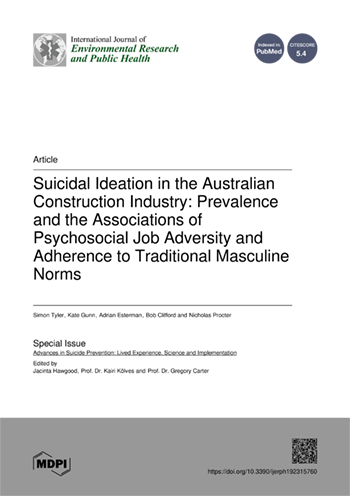
Suicidal Ideation in the Australian Construction Industry: Prevalence and the Associations of Psychosocial Job Adversity and Adherence to Traditional Masculine Norms
Publisher:
International Journal of Environmental Research and Public Health
Authors:
S Tyler, K Gunn, A Esterman, B Clifford, N Procter
Overview:
Suicide in the Australian Construction Industry (ACI) is a significant issue, however minimal understanding of suicidal ideation prevalence, as well as the potential role psychosocial job adversity an...
Suicide in the Australian Construction Industry (ACI) is a significant issue, however minimal understanding of suicidal ideation prevalence, as well as the potential role psychosocial job adversity and increased adherence to traditional masculine norms may play in its presence, is apparent. A representative sample of Australian men were used to create initial understandings of prevalence of suicidal ideation, psychosocial job adversities and level of adherence to traditional masculine norms for the ACI in comparison to a general population comprised of the remaining employed males from Other Industries.
AUS

2026
Rationale for Accreditation Criteria for the MATES in Construction Workplace Suicide Prevention Program
Publisher:
NEW SOLUTIONS: A Journal of Environmental and Occupational Health Policy
Authors:
A. LaMontagne, T. King, J. Gullestrup, T. Boldeman, N. Thompson, B. Parker, K. Dale, L. Cubbage, T. Bazley, J. Chapman
Overview:
MATES in Construction originated in Australia as a workplace suicide prevention program for predominantly male, blue-collar industries with high suicide rates. Accreditation criteria were developed fo...
MATES in Construction originated in Australia as a workplace suicide prevention program for predominantly male, blue-collar industries with high suicide rates. Accreditation criteria were developed for the purpose of providing recognition for participating sites and promoting the program. Arising from an internal review of the MATES accreditation criteria, this article presents the purpose and history of MATE’s accreditation criteria; the rationale and evidence underpinning the accreditation criteria; and the evolving practice of accreditation in the MATES context.
WA

2026
Suicidal thoughts and behaviours among construction workers: Identifying risks and protective factors
Publisher:
Science Direct: Journal of Affective Disorders
Authors:
M Kyron, J Carpini, L Kanse, G Yeo, A Page, L Cubbage
Overview:
The construction industry records concerningly high rates of suicide compared to other industries. This study aimed to (1) identify sub-groups within the industry that report elevated rates of suicida...
The construction industry records concerningly high rates of suicide compared to other industries. This study aimed to (1) identify sub-groups within the industry that report elevated rates of suicidal thoughts and behaviours, and (2) identify patterns of risk and protective factors that may inform suicide risk. A large representative sample of construction workers in Western Australia (N = 1743) participated in a cross-sectional survey. Participants reported recent suicidal ideation, plans and attempts. Associations with personal life and workplace risk factors were examined through decision tree models, and classification accuracy examined through ensemble machine-learning modelling.
AUS
2026
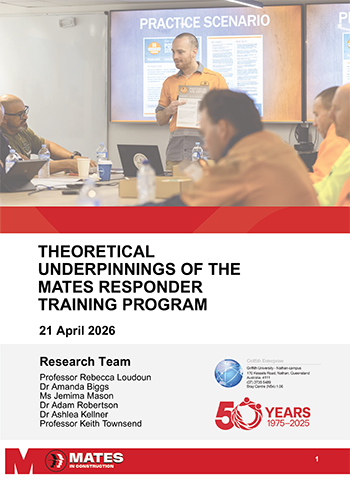
Theoretical Underpinnings of the MATES Respond Training Program
Publisher:
Griffith University
Authors:
R. Loudoun, A. Biggs, J. Mason, A. Robertson, A. Kellner, K. Townsend
Overview:
The MATES Respond Training program is delivered to individuals and designed to improve their responder skills after critical incidents and build preparedness for future events. Participants go through...
The MATES Respond Training program is delivered to individuals and designed to improve their responder skills after critical incidents and build preparedness for future events. Participants go through a series of connected modules that facilitate engagement with the critical incident, foster a shared understanding of its impacts, and enable effective support for affected workers and the wider site.
QLD / NT
2026
Development and Validation of the MATES Trust in Case Managers Measure
Publisher:
Griffith University
Authors:
R. Loudoun, A. Biggs, K. Townsend, A. Robertson, A. Kellner, J. Mason
Overview:
The purpose of this project was to evaluate the psychometric properties of a measure of workers’ trust in MATES case managers and to examine its relationship with help-seeking and other theoretically ...
The purpose of this project was to evaluate the psychometric properties of a measure of workers’ trust in MATES case managers and to examine its relationship with help-seeking and other theoretically related constructs.
QLD / NT
2026
Evaluation of a Workplace Mental Health Accreditation Program in Northern Territory Construction
Publisher:
Wiley, Mental Health Science
Authors:
N.Thompson, A. Robertson, A. Biggs, K. Townsend, J. Mason, A. Chapman, J. Finn, A. Kellner, R. Loudoun
Overview:
The Australian construction industry is characterized by elevated suicide risk and widespread exposure to psychosocial hazards. The Northern Territory (NT) presents a particularly high‐risk context, w...
The Australian construction industry is characterized by elevated suicide risk and widespread exposure to psychosocial hazards. The Northern Territory (NT) presents a particularly high‐risk context, with the highest suicide rates nationally and a geographically dispersed, highly mobile workforce. This study examines mental health outcomes in the NT construction workforce and evaluates a workplace mental health accreditation model implemented across construction sites.
AUS
2026
MATES in Energy: “State of the Industry”
Publisher:
Griffith Enterprise
Authors:
R. Loudoun, A. Robertson, J. Mason, A. Kellner, A. Biggs, K. Townsend
Overview:
This report presents findings from a scoping review examining mental health and suicide related outcomes in the energy sector workforce. The review synthesised peer-reviewed research and relevant indu...
This report presents findings from a scoping review examining mental health and suicide related outcomes in the energy sector workforce. The review synthesised peer-reviewed research and relevant industry and policy literature to identify what is currently known about mental health outcomes, workplace risk factors, and the effectiveness of interventions across electricity generation, transmission, and distribution contexts. In total, 45 empirical studies published since 2000 were identified and analysed, supplemented by relevant Australian and international grey literature providing sector benchmarking and policy context. Across the literature, mental health outcomes in energy-sector workforces are most commonly examined through indicators of psychological distress such as depression, anxiety, burnout and stress. Evidence consistently links these outcomes to modifiable aspects of work organisation and psychosocial risk exposure.
AUS
2025
Managing Psychosocial Health Risks in the Australian Construction Industry: A Holistic Hazard Management Intervention
Publisher:
MDPI
Authors:
A Biggs, A Kellner, A Robertson, J Mason, K Townsend, S Jowers Page, N Thompson, R Loudoun.
Overview:
This study presents a case study of a holistic, psychosocial hazard management intervention program in a project-based, remote workforce in the Australian construction industry. There is a dearth of r...
This study presents a case study of a holistic, psychosocial hazard management intervention program in a project-based, remote workforce in the Australian construction industry. There is a dearth of research on targeted, integrative, multi-level wellbeing interventions, and we seek to address this gap. Given the high rates of psychological distress and suicide in construction, understanding these hazards and the responses needed to manage them is critical for prevention. Data were collected from workers before and after the implementation of an intervention using an empirically validated measure of the work environment underpinned by the job demands–resources framework to evaluate exposure to psychosocial hazards, and mental health indicators, including psychological distress and suicidal ideation.
AUS
2025
What is the Role of Industry-Based Intermediary Organisations in Supporting Workplace Mental Health in Australia? A Scoping Review
Publisher:
International Journal of Environmental Research and Public Health
Authors:
K Burns, L Ellis, A Neto, C Lopes and J Amin
Overview:
Despite increasing interest in workplace mental health, limited attention has been paid to the role of industry-based intermediary organisations in delivering mental health support. This scoping revie...
Despite increasing interest in workplace mental health, limited attention has been paid to the role of industry-based intermediary organisations in delivering mental health support. This scoping review addresses this gap by examining the mental health-related activities of industry intermediaries in Australia. The findings suggest that intermediary organisations—including unions, business associations, and professional bodies—are well positioned to support tailored mental health strategies. However, the current lack of robust evaluations limits the understanding of their effectiveness. Future efforts should prioritise industry–research collaborations to strengthen the evidence base and inform sustainable investment in workplace mental health initiatives.
AUS

2025
MATES Respond Program: Peers Guiding Worksites Through Postvention and Critical Incident Support
Publisher:
Journal of Loss and Trauma: International Perspectives on Stress & Coping
Authors:
N Thompson, J Lacey, A Robertson, A Biggs
Overview:
Peer support and broadening the skillset of reflective practice as a point of connection in workplace settings, is a transformative component of postvention support after a peer’s suicide.
Peer support and broadening the skillset of reflective practice as a point of connection in workplace settings, is a transformative component of postvention support after a peer’s suicide.